|
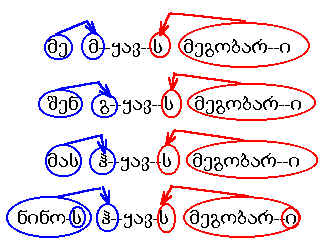
me mq'avs megobari I have a friend. Sen gyavs
megobari mas hyavs
megobari ninos hyavs
megobari |
 |
Such important verbs as I have, I want, I love, I like, I hate, I am hungry, etc. will be touched upon in this lesson. When we have learned this group and its characteristic features, the major difficulty of the Georgian verb, and perhaps of the whole Georgian grammar, will have basically been overcome.
The shared feature of these verbs in Georgian is that the subject person is presented as an experiencer, receiver or owner of the result, and not as an acting, active subject.
Thus, the Georgian verb indicates how active the subject role is in the action or state described by the verb, whether this action (or state) depends on the will of the subject or whether the subject is just a passive experiencer, receiving or perceiving the action or state.
Two main groups of Georgian verbs can be distinguished:
1. Direct verbs
2. Inversive (indirect) verbs, these are the verbs
expressing emotions and possession:
|
Subject is an acting (or presented as an acting) agent and has the v-series marker in the verb |
Subject is the experiencer or possessor and has the m-series marker in the verb |
||||||||||||||||||||||||||||||||||||||||||||||||
|
|
Direct and
inversive verbs
When the logical subject is acting on its
(his/her/its) decision, or when the action therefore is governed
by the will of the subject, its marker in the verb is a
so-called subject marker (a v-series marker), and
the verb is the direct verb:
| v- -------------
v- ----------- |
me v-wer me v-c'er |
I am writing | The first subject person |
| ø- -----------
ø- ----------- |
Sen ø-wer
shen ø-c'er |
You are writing | The second subject person |
| ------------- -s
--------------s (in certain forms -a, -o -a, -o) |
is wer-s
is c'er-s bavSv-i wer-s bavshv-i c'er-s |
He is writing | The third subject person |
| v- ------------ -T
v- ------------ -t |
Cven v-wer-T chven v-c'er-t |
We are writing | The first subject person (plural) |
| ø- ------------ -T ø- ------------- -t |
Tqven ø-wer-T tkven ø-c'er-t |
You are writing | The second subject person (plural) |
| ------------- -en -en
(in certain forms the suffixes: -es, -an, -nen, -n, -es, -an, -nen, -n) |
isini wer-en isini c'er-en bavSveb-i wer-en bavshveb-i c'er-en |
They are writing | The third subject person (plural) |
Other examples of verbs having a "willing" subject (here we present only the first subject person form):
| me v-aSeneb
me v-asheneb |
I am building |
| me v-TamaSob
me v-tamashob |
I am playing |
| me v-usmen
me v-usmen |
I am listening |
| me v-swavlob
me v-sc'avlob |
I am studying |
| me v-yidulob
me v-q'idulob |
I am buying |
| me v-yidi
me v-q'idi |
I am selling |
| me v-ambob
me v-ambob |
I am saying |
However, when the verb expresses an action or state that has happened or that is going on independently of the subject's will, the subject is not an acting subject, but an experiencing subject. Its marker in the verb is the so-called object person marker (the m-series marker) and such verbs are called inversive (indirect) verbs:
Note: the m- series markers are object markers by origin even in these verbs, but the original object, marked by the object marker in the verb, is often a human being and gets re-interpreted as a subject: subject experiencer/subject possessor even though it retains its original object marker in the verb.
Almost all stative verbs (verbs that require auxiliary verbs along with the marker v- in the present tense, e.g. vuyvarvar s/he loves me, vgonivar s/he believes me to be..., etc.) are inversive verbs.
Inversive (Indirect) verbs
| me m-civa
me m-civa |
I am freezing |
| me m-Sia
me m-shia |
I am hungry |
| me m-iyvars
me m-iq'vars |
I am in love |
| me mo-m-wons
me mo-m-c'ons |
I like |
| me m-eSinia
me m-eshinia |
I am afraid |
| me m-yavs
me m-q'avs |
I have (something/somebody that is animate) |
| me m-aqvs
me m-akvs |
I have (something that is inanimate) |
| me m-Zuls
me m-dzuls |
I hate |
| me m-jera
me m-dzhera |
I believe |
One more characteristic feature of such verbs is that the logical subject is in the dative. Thus, it is case marked as an object, it has an object marker in the verb, but nowadays it is understood as a subject. The reason for such an exchange of functions between the object and the subject may be that fact that the experiencing subject (original indirect object) is almost always a human being and, at the same time, the verb is stative:
| m- -------------
m- ----------- |
me m-cxela me m-cxela |
It is hot to me | The first subject person |
| g- -----------
g- ----------- |
Sen g-cxela
shen g-cxela |
It is hot to you | The second subject person |
| ------------- -s
--------------s (in certain forms -a, -o -a, -o) |
mas s-cxela
mas s-cxela bavSv-s s-cxela bavshv-s s-cxel-a |
It is hot to him It is hot to the child |
The third subject person |
| gv- ------------
gv- ------------ |
Cven gv-cxela chven gv-cxela |
It is hot to us | The first subject person (plural) |
| g- ------------ -T
g- ------------- -t |
Tqven g-cxela-T
tkven g-cxela-t |
It is hot to you | The second subject person (plural) |
| (s-) ------------
-T (in certain forms the prefixes: h-, ø- h- ø-) |
maT s-cxela-T
mat s-cxela-t bavSveb-s s-cxela-T bavshveb-s s-cxela-t |
It is hot to the children | The third subject (plural) |
This is not a unique phenomenon of Georgian.
Typologically the same situation is attested in Indo-European
languages too, e. g. in Russian:
| mne | nravitsja | on |
| I.Dative | like | he.Nominative |
| u | menja | jest | kniga |
| Preposition | I.Genitive | have | book.Nominative |
The translation into English is often presented with such phrases as: I am in love, I am hungry, I am afraid, etc.
The form of the first and second subject person
presented by the first and second person pronouns do not change
for case in Georgian.
Only the third person pronoun changes: is wers is c'ers, but: mas aqvs mas akvs.
Compare:
| me vwer werils |
me vc'er c'erils |
I am writing a letter |
| Sen wer werils | shen c'er c'erils | You are writing a letter |
| is wers werils | is c'ers c'erils | S/he is writing a letter |
| kaci wers werils | k'aci c'ers c'erils | A man is writing a letter |
| me maqvs werili | me makvs c'erili | I have a letter |
| Sen gaqvs werili | shen gakvs c'erili | You have a letter |
| mas aqvs werili | mas akvs c'erili | S/he has a letter |
| kacs aqvs werili | k'acs akvs c'erili | A man has a letter |
The first and the second person pronouns "compensate" for the lack of different case forms by having the person markers in the verbs: the m-series person marker signals the dative case (even if the form is the same me me, Sen shen) and the v-series person marker signals the nominative case.
|
me mq'avs megobari I have a friend. Sen gyavs
megobari mas hyavs
megobari ninos hyavs
megobari |
|
Of course, the terms "lack" and "compensation"
are just relative.
With the same success it is possible to say that
lack of the person markers in English is compensated for by
having the object case of the pronouns (he likes him) or
by the word worder (Tom likes coffee).
Conjugation of the verbs myavs mq'avs (I have) and maqvs makvs (I have) in the present
myavs mq'avs
(I have) (only about animate objects (e. g., human being or
animal) or objects that can move (e. g., a car, a bicycle)
(Present tense)
|
|
Plural |
| me m-yav-s megobari
me m-q'av-s megobari I have a friend |
Cven gv-yav-s
megobari chven gv-q'av-s megobari we have a friend |
| Sen g-yav-s megobari
shen g-q'av-s megobari you have a friend |
Tqven g-yav-T
megobari tkven g-q'av-t megobari you have a friend |
| mas h-yav-s megobari
mas h-q'av-s megobari he/she/it has a friend |
maT h-yav-T megobari
mat h-q'av-t megobari they have a friend |
maqvs makvs
(I have) (only about inanimate objects)
(Present tense)
|
|
Plural |
| me m-aqv-s saxli
me m-akv-s saxli I have a house |
Cven gv-aqv-s saxli
chven gv-akv-s saxli we have a house |
| Sen g-aqv-s saxli
shen g-akv-s saxli you have a house |
Tqven g-aqv-T saxli
tkven g-akv-t saxli you have a house |
| mas aqv-s saxli
mas akv-s saxli he/she/it has a house |
maT aqv-T saxli
mat akv-t saxli they have a house |
More information
Some indirect verbs (My name is,
I love...)
More detailed information on
inversion
Main morphological types