According to the newest sources, the oldest Georgian inscriptions precede the adoption of Christianity as the official religion in Georgia. The origin of the Georgian alphabet might be connected to the need for translating the books of Zoroastrianism, especially the "Avesta", into Georgian.
Georgian inscriptions dating from the 1st-3rd centuries C. E. have been found as a result of archaeological excavations in the ruins (nakalakari) of the old town of Nek'resi, near the village of Shilda in the Q'vareli districti of the Kakheti region in eastern Georgia. This town is known for having the oldest Christian buildings, among them a church from the fourth century. It is also famous as the setting for the hagiographic story "The Torture of Abibos from Nek'resi". (This story, the first version of which dates to the ninth century, is devoted to the life of the first bishop of Nek'resi, and his struggle against fire worship in the sixth century).
Archeological excavations in Nek'resi have been conducted since 1984 by expeditions from the State Museum of Georgia. The fire worshippers' temple (from the 2nd-4th centuries C. E.), a part of the wall of the antique town, and a palace, some wine stores (marani) and a church from the sixth century have been excavated.
The Nek'resi inscriptions, dating from the 1st-3rd centuries A.D., were found on stones in the palace from the fourth century. The stones with the oldest Georgian inscriptions were taken from other buildings and used a second time as building material for the new construction. The ageof the inscriptions has been determined on the basis of the age of the cultural layer (ceramics from the 1st-3rd centuries) existing under the building. Paleographic peculiarities of these inscriptions also indicate their archaic origin. Among the seven inscriptions found in this area,five belong to the 1st-3rd centuries A.D.
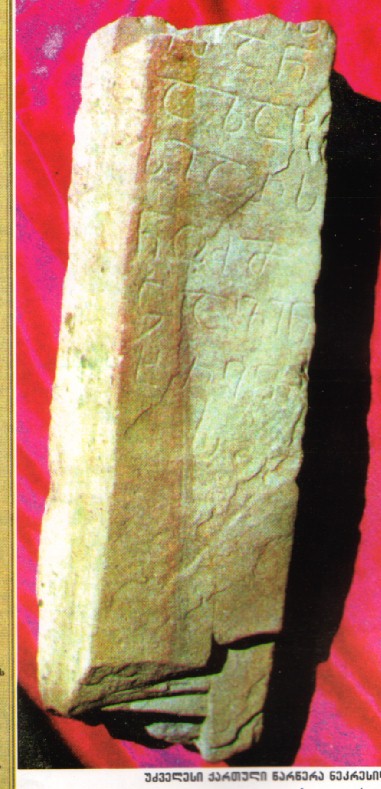
Besides these inscriptions, in 1999 a new inscriptionwas found in the center of the ruins, close to the place where the monumental church from the fourth century was being excavated. The stone with the inscription measured 41.5 x 10.5 x 5.5 cm, and it seems to be apillar from a grave. The inscription describes the personality of the buried person and contains a request not to stir up the grave. Click here view a photo.
Two special signs of this inscription are:
1. The third object marker is presented as the
prefixkh-
x- as in the oldest texts from the fifth century.
2. The Persian term "azat" (free warrior
horseman),
unknown
in other old Georgian texts, is used in the text of the
inscription.
The readable text contains six lines and might be translated as:
... is of azat (of free warrior horseman). Nobody
should
stir it up.
(= azat'isi ars. numca vin xrevs).
These inscriptions might be seen to confirm the
suggestion
that the origin of the Georgian alphabet is not necessarily
connected
to
the adoption of Christianity and that the Old Georgian
traditional
assertion
about the creation of the Georgian alphabet before Christ has
its
documented
basis.
Levan Tchilashvili, The Pre-Christian Georgian Inscriptionfrom Nek'resi, in "Kartvelologi" (Ed. Elgudzha Khintibidze), No7 2000
Levan Tchilashvili, The Pre-Christian Georgian Inscription from Nek'resi, in: "Burdzhi Erovnebisa" Fulcrum of the Nationality (Ed. Giorgi Gogolashvili), Tbilisi, 2001, N3-4,æ p. 7-8
"Sakartvelos respublika", Republic of Georgia, 2001, No182,p. 6