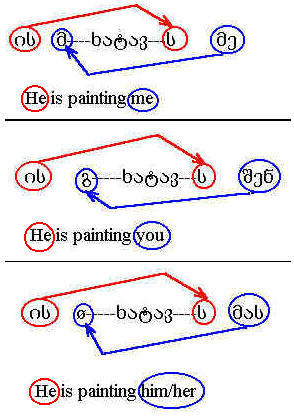
 |
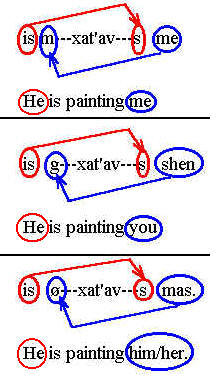 |
Variants of the subject person markers (morphological variants)
Variants of the object person markers (phonetic variants)
More details
More information: click here
The Georgian verb has different forms for the first, second and third persons of the subject, and also for singular and plural (v-xat'av, xat'av, xat'av-s, v-xat'av-t, xat'av-t xat'av-en). Compare, for instance, English (I, you, we, they paint, he paint-s). But not only does the subject (the acting person) have a marker in the verb form, but the object may also be marked.
| me | v-xatav | ma-s (levan-s) |
| me | v-xat'av | ma-s (levan-s) |
| I.Nom. (Subject) | ISubject-paint | he-Dat.Singular (Levan-Dative) (Object) |
| me v-xatav mas (levans) | Cven v-xatav-T mas (levans) |
| Sen ø-xatav mas (levans) | Tqven ø-xatav-T mas (levans) |
| is xatav-s mas (levans) | isini xatav-en mas (levans) |
Transcription
| me v-xat'av (mas, Levans) | chven v-xat'av-t (mas, Levans) |
| shen ø-xat'av (mas, Levans) | tkven ø-xat'av-t (mas, Levans) |
| is xat'av-s (mas, Levans) | isini xat'av-en (mas, Levans) |
The second subject person marker is x- x- in two verbs in modern Georgian. These verbs are: yofna q'opna to be and svla svla to go
yofna q'opna to be (present tense)
|
|
|
| me v-ar me v-ar I am | Cven v-ar-T chven v-ar-t we are |
| Sen x-ar shen x-ar you are | Tqven x-ar-T tkven x-ar-t you are |
| is ari-s is ari-s he/she/it is | isini ari-an isini ari-an they are |
Both subject and object are marked in some verb
forms (e. g.: when the first person object and the third person
subject are combined: m-xatav-s, m-xat'av-s he
is painting me /my portrait/).
The verb paints remains unchanged
in English regardless of how the object person changes but a
verb changes its form in Georgian depending not only on the
subject (acting) person, but also on the object (object of
action) person.
Both subject and object persons may have their
markers (representatives) in a Georgian verb:
|
|
In certain constructions,
only the object will be marked. Such a marking takes place for
example when the subject is the third person singular
(is he) and the direct
object is the second person plural (Tqven
you):
| Subject | Verb
(predicate) |
Direct object |
| is | g-xatav-T | Tqven |
| is | g-xat'av-t | tkven |
| he | is painting | you /Plural/ |
Both the prefix g- g- and the suffix -T -t (in the form g-xatav-T g-xat'av-t)
are markers of the object Tqven tkven
you.
The prefix g- g- denotes that the object
is the second person, and the suffix -T
-t indicates that the object is in the
plural.
Below we analyse an example where the subject
person (one who is painting) remains unchanged (in the third
person, the singular, marked with the bold) and only the
direct object person (one who/what is being painted) changes by
persons (marked with the bold italic).
| is (levan-i) | m-xatav-s | me |
| is (levan-i) | m-xat'av-s | me |
| He.Nom.(Levan-Nom.)(Subject) | I Object-paint-III Subject | I-Dat.Singular (Object) |
| is (levan-i)
m-xatav-s me
He (Levan) paints me |
is
(levan-i) gv-xatav-s Cven
He (Levan) paints us |
| is (levan-i)
g-xatav-sSen
He (Levan) paints you (singular) |
is
(levan-i) g-xatav-T
Tqven He (Levan) paints you (plural) |
| is (levan-i)
0-xatav-s mas
He (Levan) paints him/her |
is
(levan-i) 0-xatav-s maT
He (Levan) paints them |
| is
(levan-i) m-xat'av-s me
He (Levan) paints me |
is
(levan-i) gv-xat'av-s chven
He (Levan) paints us |
| is
(levan-i) g-xat'av-s shen
He (Levan) paints you (singular) |
is
(levan-i) g-xatav-t
tkven He (Levan) paints you (plural) |
| is
(levan-i) xat'av-s mas He (Levan) paints him/her |
is
(levan-i) xatav-s mat
He (Levan) paints them |
|
|
|
|
| The first object person | m- m- |
gv- gv- |
| The second object person | g- g- |
g- -----------------
-T g- ----------------- -t |
| The third object person | ø- ø- |
ø- ø- |
is me m-aqebs
is me m-akebs (he praises me)
is Sen g-aqebs
is shen g-akebs (he praises you)
is mas
ø-aqebs is mas ø-akebs
(he praises him/her)
is Cven gv-aqebs
is chven gv-akebs (he praises us)
is Tqven g-aqeb-T
is tkven g-akeb-t (he praises you)
is maT
øaqebs is mat
ø-akebs (he praises them)
Variants of the subject person markers (morphological variants) and their distribution
The first and the second subject person markers
do not change after the screeves (tense/aspect/mood forms). They
remain the same in all eleven rows (screeves) and in any verb,
while the third person subject person markers differ from one
another in certain tense/aspect/mood forms ("screeves") and
partially according to the transitivity of a verb.
|
|
|
|
| The first subject person | v-
------------------ v- ------------------ |
v- ----------------
-T v- ---------------- -t |
| The second subject person | ø- ------------------ ø- ------------------ |
ø- ------------------ -T ø- ----------------- -t |
| The third subject person | ------------------ -s,
-a,
-o ------------------ -s, -a, o |
----------------
-en,
-nen, -an, -n, -es --------------- -en, -nen, -an, -n, -es |
For example:
The first subject person:
The third person marker in the singular is -a-a in the verbs ending in the
suffixe -eb-i -eb-i in
the first and the second subject persons. In almost all other
cases the third subject person marker in the singular in the
present is -s -s:
| me me (I) | v-Tb-eb-i
v-tb-eb-i (I am warming myself) |
| Sen shen (you) | Tb-eb-i
tb-eb-i (you are warming yourselves) |
| is is s/he | Tb-eb-a
tb-eb-a (he is warming himself) |
| me me (I) | v-mRer-i
v-mgher-i (I am singing) |
| Sen shen (you) | mRer-i
mgher-i (you are singing) |
| is is s/he | mRer-i-s
mgher-i-s (he is singing) |
| me me (I) | v-aSen-eb
v-ashen-eb (I am building) |
| Sen shen (you) | aSen-eb
ashen-eb (you are building) |
| is is s/he | aSen-eb-s
ashen-eb-s (s/he is building) |
The plural (in the present tense): if the third
person marker is preceded by the vowel -i-i,
the third subject person marker in the plural is -an -an. In all other positions
the third subject person marker in the plural is -en -en:
| Cven chven (we) | v-Tb-eb-i-T
v-tb-eb-i-t (we are warming ourselves) |
| Tqven tkven (you) | Tb-eb-i-T
tb-eb-i-t (you are warming yourselves) |
| isini isini (they) | Tb-eb-i-an
tb-eb-i-an (they are warming themselves) |
| Cven chven (we) | v-mRer-i-T
v-mgher-i-t (we are singing) |
| Tqven tkven (you) | mRer-i-T
mgher-i-t (you are singing) |
| isini isini (they) | mRer-i-an
mgher-i-an (they are singing) |
| Cven chven (we) | v-aSen-eb-T
v-ashen-eb-t (we are building) |
| Tqven tkven (you) | aSen-eb-T
ashen-eb-t (you are building) |
| isini isini (they) | aSen-eb-en
ashen-eb-en (they are building) |
Distribution of the third subject person markers in the present tense
In the present tense the third subject person markers differ depending on the structure of the stem.
Observe: this classification concerns only the ending of verbs in the present tense.
|
|
|
|
| Class II verbs |
-eb-i
-eb-i |
-a
-a (Singular) -i-an
|
| Class I and III verbs
|
-VC -VC (-eb, -ob, -av, -am, -ev, etc.) |
-s -s (Singular) -en -en (Plural) |
| One subgroup of Class III verbs | -i -i (if it is not preceded by the suffix -eb, unlike the group 1 above) |
-s -s (Singular) -i-an
|
| Class IV verbs and its subgroups |
-var -var -xar -xar |
-s
-s (Singular) -an (/-T) |
| |
-i-var -i-var -i-xar -i-xar |
-i-a -i-a (Singular) -i-an
(/-i-a-T) |
| (-i-var -i-var) (-i-xar -i-xar) |
-a -a (Singular) -a(-T) |
EXAMPLES:
1. Class 1: Verbs having a direct object and ending in the sequence -VC
(vowel-consonant)
(-eb, -ob, -av, -am, -ev, etc.)
| me me (I) | v-aSen-eb
(saxls) v-ashen-eb (I am building a house) |
Cven chven(we) | v-aSen-eb-T
v-ashen-eb-t (We are building) |
| Sen shen (you) | aSen-eb
ashen-eb(You are building) |
Tqven tkven(you) | aSen-eb-T
ashen-eb-t (You are building) |
| is is (s/he) | aSen-eb-s
ashen-eb-s(S/he is building) |
isini isini(they) | aSen-eb-en
ashen-eb-en (They are building) |
| me me (I) | v-Tb-eb-i
v-tb-eb-i (I am becoming warm) |
Cven chven (we) | v-Tb-eb-i-T
v-tb-eb-i-t (We are becoming warm) |
| Sen shen (you) | Tb-eb-i
tb-eb-i (You are becoming warm) |
Tqven tkven (you) | Tb-eb-i-T
tb-eb-i-t (You are becoming warm) |
| is is s/he | Tb-eb-a
tb-eb-a (He is becoming warm) |
isini isini they | Tb-eb-i-an
tb-eb-i-an (They are becoming warm) |
| me me (I) | v-cxovr-ob
v-cxovr-ob (I live) |
Cven chven(we) | v-cxovr-ob-T v-cxovr-ob-t (We live) |
| Sen shen (you) | cxovr-ob
cxovr-ob (You live) |
Tqven tkven(you) | cxovr-ob-T cxovr-ob-t (You live) |
| is is (s/he) | cxovr-ob-s cxovr-ob-s(S/he lives) |
isini isini(they) | cxovr-ob-en cxovr-ob-en (They live) |
Class 3, subgroup ending in -i. Verbs having no direct object (or a labil
direct object) and ending in
-i. The ending -i -i
is not preceded by the suffix -eb- in the first and the second
subject persons (unlike the type 1 above) signals the ending -s -s in the third person singular and -i-an -i-an in the third person plural in
the present tense:
| me me (I) | v-mRer-i
(simReras) v-mgher-i (I am singing a song) |
Cven chven (we) | v-mRer-i-T
v-mgher-i-t (We are singing) |
| Sen shen (you) | mRer-i
mgher-i (You are singing) |
Tqven tkven (you) | mRer-i-T
mgher-i-t (You are singing) |
| is is s/he | mRer-i-s
mgher-i-s (He is singing) |
isini isini (they) | mRer-i-an
mgher-i-an (They are singing) |
| me me (I) | v-wux-var
(mis gamo) v-c'ux-var (I am worried about him) |
Cven chven (we) | v-wux-var-T
v-c'ux-var-t (We are worried) |
| Sen shen (you) | wux-xar c'ux-xar (You are worried) |
Tqven tkven (you) | wux-xar-T
c'ux-xar-t (You are worried) |
| is is s/he | wux-s c'ux-s (He is worried) |
isini isini they | wux-an c'ux-an (They are worried) |
| me me (I) | v-Can-var
v-chan-var (I am visible, I am being seen) |
Cven chven (we) | v-Can-var-T
v-chan-var-t (We are visible) |
| Sen shen (you) | Can-xar chan-xar (You are visible) |
Tqven tkven (you) | Can-xar-T
chan-xar-t (You are visible) |
| is is s/he | Can-s chan-s (He is visible) |
isini isini they | Can-an chan-an (They are visible) |
| me me (I) | v-dga-var
v-dga-var (I am standing) |
Cven chven (we) | v-dga-var-T
v-dga-var-t (We are standing) |
| Sen shen (you) | dga-xar
dga-xar (You are standing) |
Tqven tkven (you) | dga-xar-T
dga-xar-t (You are standing) |
| is is s/he | dga-s
dga-s (He is standing) |
isini isini they | dga-n-an
dga-n-an (They are standing) |
| me me (I) | v-uyvar-var
mas v-uq'var-var mas (I am loved to/by him/her) S/he loves me |
Cven chven (we) | v-uyvar-var-T
mas v-uq'var-var-t mas S/he loves us |
| Sen shen (you) | uyvar-xar mas uq'var-xar mas S/he loves you |
Tqven tkven (you) | uyvar-xar-T
mas uq'var-xar-t mas S/he loves you |
| is is s/he | uyvar-s mas uq'var-s mas S/he loves him/her |
isini isini they | uyvar-s mas uq'var-s mas S/he loves them/ uyvar-T maT uq'var-t mat They love them |
| me me (I) | v-wer-i-var
v-c'er-i-var (I am written) |
Cven chven (we) | v-wer-i-var-T
v-c'er-i-var-t (We are written) |
| Sen shen (you) | wer-i-xar
c'er-i-xar (You are written) |
Tqven tkven (you) | wer-i-xar-T
c'er-i-xar-t (You are written) |
| is is s/he | wer-i-a
c'er-i-an (He is written) |
isini isini they | wer-i-an
c'er-i-an (They are written) |
| me me (I) |
v-und-i-var
mas v-und-i-var mas (I am wanted to/by him/her) he/she wants me |
Cven chven (we) | v-und-i-var-T
mas v-und-i-var-t mas He/she wants us |
| Sen shen (you) | und-i-xar
mas und-i-xar mas He/she wants you |
Tqven tkven (you) | und-i-xar-T
mas und-i-xar-t mas He/she wants you (all) |
| is is s/he | und-a mas und-a mas He/she wants him/her/it |
isini isini they | und-a mas und-a mas He/she wants him/her und-a-T maT und-a-t mat They want them |
| - |
m-cxela me m-cxela me (me, to me) I am hot - it is hot to me |
- |
gv-cxela Cven gv-cxela chven (us) We are hot - it is hot to us |
| - | g-cxela Sen g-cxela shen (you) You are hot - it is hot to you |
- |
g-cxela-T Tqven g-cxela-t tkven (you) You are hot - it is hot to you |
| - |
s-cxela mas s-cxela mas (him/her) s/he is hot - it is hot to him/her |
- |
s-cxela-T maT s-cxela-t mat (them) They are hot - it is hot to them |
Indirect object person markers
The indirect object person has the same markers
as a direct object. The only one difference is that an indirect
object has a marker in the third person too, while a direct
object persons does not. Usually, only two person markers at the
same time may be presented in the Georgian verb.
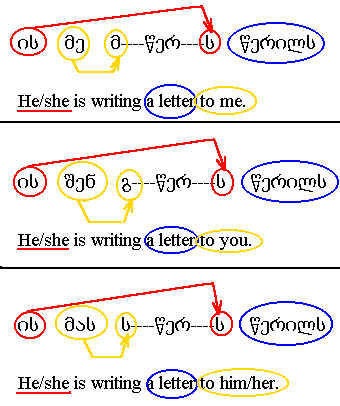
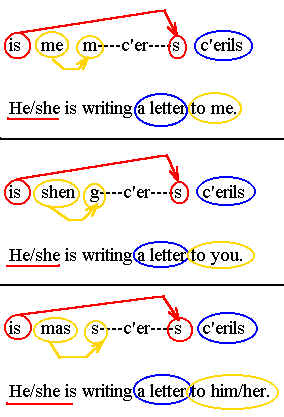
In the example below the subject is marked with red, the direct object with blue, and the indirect object with yellow. The
subject and the indirect object have their markers in the verb,
while the direct object has no marker ("no blue marker in the
verb"):
 |
 |
An indirect object marker in the third person may be presented with these phonetic variants:
|
|
|
|
| The first object person | m- m- |
gv- gv- |
| The second object person | g- g- |
g- -----------------
-T g- ----------------- -t |
| The third object person | ø- / h- / s-
ø- / h- / s- |
ø-
/ h- / s- ø- / h- / s- |
|
|
|
|
|
|
| is (he/she) | me (the first object person) (to me) | m-wer-s(write) | werils (letter) | 1 |
| is (he/she) | Sen (the second object person) (to you) | g-wer-s | werils | 2 |
| is (he/she) | mas (the third object person) (to him) | s-wer-s | werils | 3 |
| is (he/she) | mas(the third object person) (to him) | h-kiTxav-s | ambavs | 4 |
| is (he/she) | mas (the third object person) (to him) | ø-ukiTxav-s | wigns | 5 |
Transliteration
|
|
|
|
|
|
| is (he/she) | me (the first object person) (to me) | m-c'er-s (write) | c'erils (letter) | 1 |
| is (he/she) | shen (the second object person) (to you) | g-c'er-s | c'erils | 2 |
| is (he/she) | mas (the third object person) (to him) | s-c'er-s | c'erils | 3 |
| is (he/she) | mas (the third object person) (to him) | h-k'itxav-s | ambavs | 4 |
| is (he/she) | mas (the third object person) (to him) | ø-uk'itxav-s | c'igns | 5 |
Translation
(The order of the words in English is not the
same as in Georgian)
|
|
|
|
|
|
| he/she | is writing | a letter | to me | 1 |
| he/she | is writing | a letter | to you | 2 |
| he/she | is writing | a letter | to him/her | 3 |
| he/she | will ask | (about) news | him/her | 4 |
| he/she | is reading | a book | to him | 5 |
The tendency to lose the third person indirect object marker is evidenced in the western dialects of Georgian and in the modern standard Georgian.
More details
Since the subject and object persons are marked in
the verb form, the word order is more or less free in Georgian.
All these forms below express one and the same meaning:
| is me mxatavs
is me mxat'avs |
| is mxatavs me
is mxat'avs me |
| me is mxatavs
me is mxat'avs |
| me mxatavs is
me mxat'avs is |
The same feature of the
Georgian verb means that the first and the second person
pronouns have one and the same form regardless of whether they
function as the subject or the object in the sentence. The
form of the pronoun does not change and no change in word
order is necessary either. The form of the verb shows the
function of the first and the second person pronouns:
|
||||||||
| Regardless of the
word order in this sentences, Sen
shen (you) remains the subject (one who is
painting). Its marker is "zero-marker" in the verb. me me (I) remains the object
(one who is being painted), marked with the first
object person marker m- m- in the verb.
The first person pronoun has no special form for the dative case (the case of the object person in the present tense). Instead, it has an object marker in the verb. |
|
||||||||
| Regardless of the
word order in this sentences, Sen
shen (you) remains the object (one who is being
painted). Its marker is the prefix g- g- in the verb. me me (I) remains the subject
(one who is painting). Its marker is "zero-marker" in
the verb. The second person pronoun has no special form for the dative case (the case of the object person in the present tense). Instead, it has an object marker in the verb. |
The inversive verb
| m- | i-yvar | -s |
| m- | i-q'var | -s |
| The first object person marker | Relation marker-love | The third subject person marker |
| I | love | him / her / it |
Compare:
The non-inversive, direct verb
| m- | wer | -s |
| m- | c'er | -s |
| The first object person marker | write | The third subject person marker |
| me | write | he / she / it |
Case marking is also inversive in these verbs: the subject person is marked by the dative case, while the object person is marked by the nominative case. This is more obvious in the third person (because the first and the second person personal pronouns do not change the form in nominative and dative):
The inversive verb
| daTo-s | ø-u-yvar-s | nana |
| Dato-s | ø-u-q'var-s | Nana-ø |
| Dato-Dative | The third obj. pers. marker-Rel.mark.-love-The third subject person marker | Nana-Nominati |
Inversion in the three series:
As is mentioned above, in certain types of the
verbs -- verbs, denoting possession (e. g.: me
maqvs saxli me makvs saxli I have a
house) and verbs expressing feelings, emotions (e. g.: me mciva me mciva It is cold to
me; me miyvars me miq'vars I
love) -- inversion occurs in all three series. A subject
(either a subject having something or somebody, or an
experiencing subject) is marked as an object in the verb form;
e. g.:
| me | m-aqv-s | saxl-i |
| me | m-akv-s | saxl-i |
| I.Dat | 1Obj.-have-3subject | house-Nom. |
A subject of such verbs occurs as a possessor or
as an experiencer (/experiencing) subject, which means that the
subject is not active (or agentive), but rather passive. It is
just experiencing the feeling or receiving the thing that is
given (or that belongs) to him/her.
Thus, subject is marked by m-series markers in these verbs in
all three series.
Inversion only in
the third series
Inversion is
evidenced in the III series forms of certain types of direct
verbs (Type 2, 3, 4, 5). In the third series action
expressed by a verb is represented more as a result, than as a
process. The possessor of the result (logical subject) is
marked as an object in the verb form. e. g.
| me | da-m-iwer-ia |
| me | da-m-ic'er-ia |
| I.Dat. | Preverb-IObject-write-Them. suffix |
It is just the result, and not the process of writing, that is emphasised here. The first person, the one who has written, is represented not as an actor, one who is acting, but as a possessor of a result. That is why it is marked by the dative case and it is marked as an object in the verb form.
This function
of the perfect (// the first resultative) and the pluperfect
(// the second resultative), to emphasise the result and not
the process, dictates that these formes be used when the
person telling the story has not seen an action or a process,
but has witnessed the result of the action.
| ninos | werili | dauweria |
| Nino-s | c'eril-i | da-u-c'er-ia |
| Nino-Dat. | letter-Nom. | Preverb-Rel.marker-write.Root-Resultative 1 |
Conjugation
of
the verbs myavs mq'avs (I
have) and maqvs makvs (I
have) in the present
myavs mq'avs
(I have) (only about an animate object or an object that can
move, e. g., a car, a bicycle)
(Present tense)
|
|
|
| me m-yav-s is me
m-q'av-s
is I have him/her/it |
Cven gv-yav-s is chven gv-q'av-s is we have him/her/it |
| Sen g-yav-s is shen g-q'av-s is you have him/her/it | Tqven g-yav-T is tkven g-q'av-t is you have him/her/it |
| mas h-yav-s is mas h-q'av-s is he/she/it has him/her/it | maT h-yav-T is mat h-q'av-t is they have him/her/it |
maqvs
makvs (I have) (only about inanimate object)
(Present tense)
|
|
|
| me m-aqv-s is me m-akv-s is I have him/her/it | Cven gv-aqv-s is chven gv-akv-s is we have him/her/it |
| Sen g-aqv-s is shen g-akv-s is you have him/her/it | Tqven g-aqv-T is tkven g-akv-t is you have him/her/it |
| mas ø-aqv-s is mas ø-akv-s is he/she/it has him/her/it | maT ø-aqv-T is mat ø-akv-t is they have him/her/it |
© Manana Kock Kobaidze & Karina Vamling