|
Subject is in the nominative case Direct object is in the dative case: 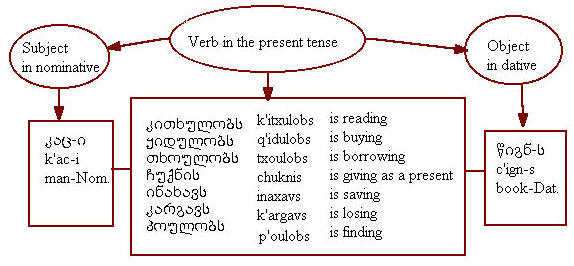 |
Nouns
Nouns denote things and answer the questions: who?
and
what? e. g.: man, woman, table, etc.
Group vin (vin who)
| kaci | qali | bavSvi | maswavlebeli | eqimi |
| k'aci | kali | bavshvi | masc'avlebeli | ekimi |
| man | woman | child | teacher | doctor |
Group ra (ra what)
| qaTami | kata | mgeli | skami | burTi |
| katami | k'at'a | mgeli | sk'ami | burti |
| hen | cat | wolf | chair | ball |
etc.
To divide reality into human and non human entities and to unify animate and inanimate things into one class is not a feature special to Georgian; Such unification is found also in Indo-European languages, for instance in English (pronoun it).
Grammatical
number of nouns
Nouns have two numbers in Georgian: singular and
plural.
A noun in the singular is a sequence of a stem morpheme
and
a
case marker, and in the plural, a sequence of a stem morpheme,
a
plural marker -eb -eb, and a case
marker:
|
|
|
||||||||||||||||||||
|
|
Note: Plural forms (like in Old Georgian) formed by the suffixes -n -n and T/-Ta -t /-ta are also found. They have a stylistic function connected to poetic and higher style, and also to the terminology and name giving in modern standard Georgian, e. g.:
sabWo-Ta kavSiri sabch'o-ta k'avshiri (The Soviet Union)
More information:
Plural of substantives
formed
by the suffixes -n/-ta in Old Georgian and in modern dialects
The plural formed by the suffixes -n / -Ta -n / -ta was usual in Old Georgian although plural formed by the suffix -eb-eb is also evidenced even in the oldest texts.
The plural is formed by adding the plural marker -n -n to the stem in the nominative and the vocative. The suffix -T/-Ta -t / -ta formed all other cases in Old Georgian. The suffix -n -n is a plural marker followed by case markers (-i in the nominative and -o in the vocative), while the suffix -T/-Ta -t / -ta is a fusional marker both for number and case, e. g.:
Plural in Old Georgian (kaci k'aci man)
| Nominative | kac-n-i | k'ac-n-i |
| Vocative | kac-n-o | k'ac-n-o |
| All other cases | kac-Ta | k'ac-ta |
Plural forms formed by the suffixes -n
-n
and T/-Ta -t /-ta are also found in modern
Georgian
They have a stylistic function connected to poetic and higher style,
and
also to the terminology and name giving in modern standard Georgian, e.
g.:
sabWo-Ta kavSiri sabch'o-ta
k'avshiri (The Soviet Union)
qalTa dRe kalta
dge
(Women's day)
etc.
In modern standard Georgian, the suffixes -T/-Ta -t/-ta usually expresses the genitive case. In modern dialects in the mountainous regions it can express the ergative, the dative and the genitive cases. The plural formed by the suffix -eb -eb is also usual in these dialects.
N o t e:
Not all nouns can form the plural. Like in other
languages,
material nouns (name of materials), usually do not form the plural: rkina
rk'ina
iron, wyali c'q'ali
water, oqro
okro
gold etc.
Some nouns, singular by form,
denote
a group and have the semantics of plural (collective nouns). Verbs used
with them are in the singular; e. g.:
| xalxi | icini-s |
| xalxi | icini-s |
| people | is laughing (Singular) |
People laugh, people are laughing; comp.:
| bavSv-eb-i | icini-an |
| bavshv-eb-i | icini-an |
| child-Plural-Nominative | are laughing (Plural) |
Children are laughing
Some verbs have different roots
to
reflect the semantics of plural of the collective noun (subject):
|
|
|
|
| kaci ijd-a | xalxi isxd-a | kac-eb-i isxd-nen |
| k'ac-i idzhd-a | xalxi isxd-a | k'ac-eb-i isxd-nen |
| man-Nom. sit-III Sub.+Sing. | people sit-III Sub.+Sing. | men sit-III Sub.+plural |
| A man was sitting, sat | people were sitting, sat | Men were sitting, sat |
General information about declension
Nouns conform to one declension, with variant forms
for
consonantal and vocalic stems. Differences in declension connected to
the
consonantal
(stems ending in a consonant) and vocalic stems (stems ending
in
a vowel) are considered in the chapter Declension of nouns. Only
the
general information is presented here.
Georgian has seven cases:
Differences among some groups of nouns in declension are mainly due to phonetic factors. On the basis of those factors nouns are divided into five main groups:
1. Non-reducible
stems
ending in a consonant (non-reducible consonantal stems)
2. Reducible stems
ending in a consonant (reducible consonantal stems)
3. Stems
ending in the vowel -a (truncated, or clippable) vocalic stems
4. Stems
ending in the vowel -e (truncated, or clippable only in singular) vocalic stems
5. Stems
ending
in the vowels -o, -u (non-truncated, or non-clippable) vocalic stems (there are also
two or three common names ending in the vowel -i in this group)
There are some other nuances but they will not be touched upon here.
Distribution of case markers after the consonantal and vocalic stems
|
|
(Stems ending in -a and -e) |
Non-clippable
vocalic stems (Stems ending in -o and -u) |
|
| Nominative |
|
|
|
| Ergative |
|
|
|
| Dative |
|
|
|
| Genitive |
|
|
|
| Instrumental |
|
|
|
| Adverbial |
|
|
|
| Vocative |
|
|
|
Distribution of case markers after the consonantal and vocalic stems (Transcription)
|
|
|
Non-clippable vocalic stems | |
| Nominative |
|
|
|
| Ergative |
|
|
|
| Dative |
|
|
|
| Genitive |
|
|
|
| Instrumental |
|
|
|
| Adverbial |
|
|
|
| Vocative |
|
|
|
Examples of declension:
|
|
|
|
| Nominative | qal-i | kal-i |
| Ergative | qal-ma | kal-ma |
| Dative | qal-s(a) | kal-s(a) |
| Genitive | qal-is(a) | kal-is(a) |
| Instrumental | qal-iT(a) | kal-it(a) |
| Adverbial | qal-ad | kal-ad |
| Vocative | qal-o | kal-o |
|
|
|
|
| Nominative | qal-eb-i | kal-eb-i |
| Ergative | qal-eb-ma | kal-eb-ma |
| Dative | qal-eb-s(a) | kal-eb-s(a) |
| Genitive | qal-eb-is(a) | kal-eb-is(a) |
| Instrumental | qal-eb-iT(a) | kal-eb-it(a) |
| Adverbial | qal-eb-ad | kal-eb-ad |
| Vocative | qal-eb-o | kal-eb-o |
Stems ending in vowels (vocalic stems):
|
|
|
|
| Nominative | deda-ø | deda-ø |
| Ergative | deda-m | deda-m |
| Dative | deda-s(a) | deda-s(a) |
| Genitive | ded-is(a) | ded-is(a) |
| Instrumental | ded-iT(a) | ded-it(a) |
| Adverbial | deda-d | deda-d |
| Vocative | deda-v (//-o) | deda-v (//-o) |
|
|
|
|
| Nominative | ded-eb-i | ded-eb-i |
| Ergative | ded-eb-ma | ded-eb-ma |
| Dative | ded-eb-s(a) | ded-eb-s(a) |
| Genitive | ded-eb-is(a) | ded-eb-is(a) |
| Instrumental | ded-eb-iT(a) | ded-eb-it(a) |
| Adverbial | ded-eb-ad | ded-eb-ad |
| Vocative | ded-eb-o | ded-eb-o |
More particularly
Stems ending
in consonant form two groups:
1) Non-reducible stems: neither stem nor case marker undergo any change either in the singular or in the plural, e. g.: saxl-i, saxl-is, saxl-eb-i... (Table 1).
2) Reducible stems: reduction of a stem vowel occurs in the genitive, instrumental and adverbial cases in the singular and in all seven cases in the plural. Stems ending in a syllable consisting of the vowel -a or -e (-a or -e), also -o -o, and the sonorants -l, -m, -n, -r (-l, -m, -n, -r) belong to this group. These syllables are:
-al, -am, -an, -ar (-al,
-am,
-an, -ar)
-el, -em, -en, -er (-el,
-em,
-en, -er)
-ol, -om, -on, -or (-ol,
-om,
-on, or)
E g.: wyali-i wyl-is
c'q'al-i c'q'l-is water -Nom- water-Gen.
mter-i mtr-is mt'er-i
mt'r-is enemy-Nom- enemy -Gen
Declension of reducible stems is represented in the Table
2a.
The so-called emphatic vowel -a-a
may be presented in the dative, genitive and instrumental after
both reducible and
non-reducible stems (both in the singular and the plural)
in certain positions, but even in these positions (where the emphatic
vowel -a -a is allowed) forms
without
the emphatic -a are also permitted. This -a is presented in the
brackets
in the tables below.
N o t e 1.
The vowel -o -o
preceded
or followed by bilabial sounds does not leave any trace after reduction
(Table
2b).
In other positions, the sonorant -v appears as a result of reduction of
the vowel
-o -o (Table
2c).
N o t e 2
Reduction does not occur in anthrophonyms (proper names
of humans), nor in proper names of animals; comp.:
Nom. qamar-i kamar-i
(a
belt)
Gen. qamr-is kamr-is
but:
Nom. Tamar-i Tamar-i
(the name of a woman)
Gen. Tamar-is Tamar-is
Reduction takes place in place names (likewise ordinary appelatives // common names):
Nom. yvarel-i
q'varel-i
(a name of a town)
Gen. yvarl-is q'varl-is
N o t e 3
In some homonym pairs, reducible and non-reducible
forms
distinguish the different stems; e. g.:
non-reducible stem Tval-i tval-i
means "eye", reducible stem Tval-i tval-i
means
"wheel", also "gem":
Non-reducible Tval-i tval-i eye:
Nom.
Tval-i Tval-ebi tval-i
tval-eb-i
Gen. Tval-is Tval-eb-is tval-is
tvaleb-is
Reducible Tval-i tval-i
wheel;
gem:
Nom. Tval-i Tvl-eb-i tval-i
tvl-eb-i
Gen. Tvl-is Tvl-eb-is
tvl-is
tvleb-is
Likewise: the non-reducible stem wel-i c'el-i means "waist", the reducible stem wel-i c'el-i means "year".
N o t e 4
Besides stems ending in the sonorants -l
-m -n -r ( -l, -m, -n, -r), stems ending in the voiced
consonant
-b
-b
may also undergo reduction (Table
2d). -b -b shows features of
sonorants
in some other positions too. Reduction takes place in one stem ending
in
voiceless abruptive y q' (in west
Georgian
dialects) (Table
2e).
Table 1. A Declension of a non-reducible stem
saxli
saxli
house
|
|
|
|
| Nominative | saxl-i | saxl-eb-i |
| Ergative | saxl-ma | saxl-eb-ma |
| Dative | saxl-s | saxl-eb-s |
| Genitive | saxl-is | saxl-eb-is |
| Instrumental | saxl-iT | saxl-eb-iT |
| Adverbial | saxl-ad | saxl-eb-ad |
| Vocative | saxl-o | saxl-eb-o |
Transcription
|
|
|
|
| Nominative | saxl-i | saxl-eb-i |
| Ergative | saxl-ma | saxl-eb-ma |
| Dative | saxl-s | saxl-eb-s |
| Genitive | saxl-is | saxl-eb-is |
| Instrumental | saxl-it | saxl-eb-it |
| Adverbial | saxl-ad | saxl-eb-ad |
| Vocative | saxl-o | saxl-eb-o |
Table 2a Declension of a reducible stem
bali
bali cherry
|
|
|
|
| Nominative | bal-i | bl-eb-i |
| Ergative | bal-ma | bl-eb-ma |
| Dative | bal-s | bl-eb-s |
| Genitive | bl-is | bl-eb-is |
| Instrumental | bl-iT | bl-eb-iT |
| Adverbial | bl--ad | bl-eb-ad |
| Vocative | bal-o | bl-eb-o |
Transcription
|
|
|
|
| Nominative | bal-i | bl-eb-i |
| Ergative | bal-ma | bl-eb-ma |
| Dative | bal-s | bl-eb-s |
| Genitive | bl-is | bl-eb-is |
| Instrumental | bl-it | bl-eb-it |
| Adverbial | bl-ad | bl-eb-ad |
| Vocative | bal-o | bl-eb-o |
Back to Stems ending in consonants
Table 2b: -o does not leave any trace after reduction:
foToli potoli leaf
|
|
|
|
| Nominative | foTol-i | foTl-eb-i |
| Ergative | foTol-ma | foTl-eb-ma |
| Dative | foTol-s(a) | foTl-eb-s(a) |
| Genitive | foTl-is(a) | foTl-eb-is(a) |
| Instrumental | foTl-iT(a) | foTl-iT(a) |
| Adverbial | foTl-ad | foTl-eb-ad |
| Vocative | foTol-o | foTl-eb-o |
Transcription
|
|
|
|
| Nominative | potol-i | potl-eb-i |
| Ergative | potol-ma | potl-eb-ma |
| Dative | potol-s(a) | potl-eb-s(a) |
| Genitive | potl-is(a | potl-eb-is(a) |
| Instrumental | potl-it(a) | potl-eb-it(a) |
| Adverbial | potl-ad | potl-eb-ad |
| Vocative | potol-o | potl-eb-o |
Table 2c: v- as a trace after reduced -o:
mindori mindori field
|
|
|
|
| Nominative | mindor-i | mindvr-eb-i |
| Ergative | mindor-ma | mindvr-eb-ma |
| Dative | mindor-s(a) | mindvr-eb-s(a) |
| Genitive | mindvr-is(a) | mindvr-eb-is(a) |
| Instrumental | mindvr-iT(a) | mindvr-eb-iT(a) |
| Adverbial | mindvr-ad | mindvr-eb-ad |
| Vocative | mindor-o | mindvr-eb-o |
|
|
|
|
| Nominative | mindor-i | mindvr-eb-i |
| Ergative | mindor-ma | mindvr-eb-ma |
| Dative | mindor-s(a) | mindvr-eb-s |
| Genitive | mindvr-is(a) | mindvr-eb-is(a) |
| Instrumental | mindvr-it(a) | mindvr-eb-it(a) |
| Adverbial | mindvr-ad | mindvr-eb-ad |
| Vocative | mindor-o | mindvr-eb-o |
Table 2d: Reducible stem ending in -b -b
xoxobi xoxobi pheasant
|
|
|
|
| Nominative | xoxob-i | xoxb-eb-i |
| Ergative | xoxob-ma | xoxb-eb-ma |
| Dative | xoxob-s | xoxb-eb-s |
| Genitive | xoxb-is(a) | xoxb-eb-is(a) |
| Instrumental | xoxb-iT-(a) | xoxb-eb-iT-(a) |
| Adverbial | xoxb-ad | xoxb-eb-ad |
| Vocative | xoxob-o | xoxb-eb-o |
Transcription
|
|
|
|
| Nominative | xoxob-i | xoxb-eb-i |
| Ergative | xoxob-ma | xoxb-eb-ma |
| Dative | xoxob-s | xoxb-eb-s |
| Genitive | xoxb-is(a) | xoxb-eb-is(a) |
| Instrumental | xoxb-it(a) | xoxb-eb-it(a) |
| Adverbial | xoxb-ad | xoxb-eb-ad |
| Vocative | xoxob-o | xoxb-eb-o |
Back to Stems ending in consonants
Back to
General information
about Declension
Back to Grammar
Table 2e: Reducible stem ending in y q'
arayi araq'i vodka
|
|
||
| Nominative | aray-i | araq'-i |
| Ergative | aray-ma | araq'-ma |
| Dative | aray-s(a) | araq'-s(a) |
| Genitive | ary-is(a) | arq'-is(a) |
| Instrumental | ary-iT(a) | arq'-it(a) |
| Adverbial | ary-ad | arq'-ad |
| Vocative | aray-o | araq'-o |
More information about reduction
Not all common nouns ending in such syllables (a / e
/
o + l m n r) undergo reduction. Two groups may be considered here:
monosyllabic
stems and stems consisting of more than one syllable.
a) If in monosyllabic stems a consonant cluster
expected
after reduction is a cluster with the increasing fricativeness,
reduction
may occur, otherwise reduction is not expected (Tevdore
uTurgaiZe, qarTuli enis fonematuri struqtura, Tevdore
Uturgaidze, Kartuli enis ponemat'uri st'rukt'ura, Tbilisi,
Mecniereba,
1976); e. g.:
Nom. skam-i (chair)
Gen. skam-is
Reduction does not occur because after reduction an
"unnatural"
cluster with the discrete fricativeness skm-
would have been formed.
b) If a stem consists of more than one syllable, reduction may occur even if a discrete or decreasing fricativity consonant cluster is expected as a result of reduction, because such a cluster, formed after the reduction, is usually divided between two vowels and belongs to two different syllables. (Tevdore uTurgaiZe, qarTuli enis fonematuri struqtura, Tevdore uturgaidze, Kartuli enis ponemat'uri st'rukt'ura,Tbilisi, Mecniereba, 1976); e. g.:
Nom. qaTam-i (a
hen)
Gen. qaTm-is
A stem that does not undergo a reduction may be reduced as the constituent part of a composed word:
Nom. kar-i (door)
Gen. kar-is
comp.
Nom. ciskar-i
(morning,
morn)
Gen. ciskr-is
In some monosyllabic stems, where the reduction takes place in Modern Georgian, reduction did not occur in Old Georgian; e. g.:
Old Georgian:
Nom. juar-i (cross)
Gen. juar-is
Modern Georgian:
Nom. jvar-i
Gen. jvr-is
Examples of the reversed examples are also found.
According to Chikobava, the reason for reduction must have been an intensive dynamic stress supposed in Old Georgian (A. Chikobava...). But for Uturgaidze, the number of syllables and the quality of a consonant cluster, expected after the possible reduction, are decisive factors (Tevdore Uturgaidze 1976), while for Mar, an original reason for the reduction must have been the sonant nature of the consonants l, m, n, r (Niko Mar, Grammatika Drevneliteraturnogo Gruzinskogo jazyka, Sankt-Peterburg, 1925).
Declension of personal
proper
names ending in a consonant
First names ending in a consonant (including foreign
names) take the nominative case marker -i
-i:
| Nominative | nodar-i | Tamar-i | riCard-i | maikl-i |
| Ergative | nodar-ma | Tamar-ma | riCard-ma | maikl-ma |
| Dative | nodar-s | Tamar-s | riCard-s | maikl-s |
| Genitive | nodar-is(a) | Tamar-is(a) | riCard-is(a) | maikl-is(a) |
| Instrumental | nodar-iT | Tamar-iT | riCard-iT | maikl-iT |
| Adverbial | nodar-ad | Tamar-ad | riCard-ad | maikl-ad |
| Vocative | nodar-ø | Tamar-ø | riCard | maikl |
| Nominative | nodar-i | tamar-i | richard-i | maikl-i |
| Ergative | nodar-ma | tamar-ma | richard-ma | maikl-ma |
| Dative | nodar-s | tamar-s | richard-s | maikl-s |
| Genitive | nodar-is(a) | tamar-is(a) | richard-is(a) | maikl-is(a) |
| Instrumental | nodar-it | tamar-it | richard-it | maikl-it |
| Adverbial | nodar-ad | tamar-ad | richard-ad | maikl-ad |
| Vocative | nodar-ø | tamar-ø | richard | maikl |
Surnames ending in -shvili and -dze are declined as
common
names.
Surnames ending in -a are declined as first names
ending
in a vowel (stem does not undergo any change).
When the first name and surname are declined
together,
only the surname is declined and the first name remains unchanged:
| Nominative | nodar gagoSiZe-ø | nodar gagoshidze-ø |
| Ergative | nodar gagoSiZe-m | nodar gagoshidze-m |
| Dative | nodar gagoSiZe-s | nodar gagoshidze-s |
| Genitive | nodar gagoSiZ-is | nodar gagoshidz-is |
| Instrumental | nodar gagoSiZ-iT | nodar gagoshidz-it |
| Adverbial | nodar gagoSiZe-d | nodar gagoshidze-d |
| Vocative | nodar gagoSiZe-v | nodar gagoshidze-v |
The title or name of profession followed by proper names is partially declined:
| Nominative | eqim-i nodar gagoSiZe-ø | ekim-i nodar gagoshidze-ø |
| Ergative | eqim-ma nodar gagoSiZe-m | ekim-ma nodar gagoshidze-m |
| Dative | eqim nodar gagoSiZe-s | ekim nodar gagoshidze-s |
| Genitive | eqim nodar gagoSiZ-is | ekim nodar gagoshidz-is |
| Instrumental | eqim nodar gagoSiZ-iT | ekim nodar gagoshidz-it |
| Adverbial | eqim nodar gagoSiZe-d | ekim nodar gagoshidze-d |
| Vocative | eqim-o nodar gagoSiZe-v | ekim-o nodar gagoshidze-v |
Vocalic stems
.Stems
ending in the vowels -a -a and -e
-e
Stems ending in vowels form two groups:
3. Stems ending in the vowel -a
Nouns ending in the vowel -a -a
have the zero-marker ø in the nominative in the singular. They
drop
the last -a in the genitive and instrumental cases in the singular and
in all seven cases in the plural (Table
3).
4. Stems ending in the vowel -e
Nouns ending in the vowel -e -e
have the zero-marker ø in the nominative in the singular. Nouns
ending in the vowel -e -e drop the last -e
-e
in the genitive and instrumental cases in the singular, but retain it
in
all seven cases in the plural (Table
4).
N o t e 1:
The emphatic vowel -a -a
may be presented in the dative, genitive and instrumental cases after
the clippable stems (both in the singular and plural) in definite
positions,
but even in these positions (where the emphatic vowel -a-a
is
allowed) forms without the emphatic -a are also permitted. This -a is
presented
in the brackets in the tables below.
N o t e 2.
Anthroponyms ending in -a -a
and -e -e do not drop the last vowel in
the
singular. Instead of stems, the case markers undergo changes: the case
markers in the genitive, instrumental and adverbial cases drop the
vocal
in modern Georgian (Table
5a). This applies to the appelatives (common names) equated with
proper
nouns as well (Table
5b). When the vocal part of the case marker is reduced, the
emphatic
vowel -i is presented instead of the emphatic vowel -a
-a
in these cases (gen., instr.).
N o t e 3
In Old Georgian, stems ending in the reducible -a
-a
and -e -e declined almost the same
way as in modern
Georgian
(Table
3b and Table
4b). Vocal part of the case marker preceded by non-reducible stem
vowel
-a
-a
or -e -e, was reduced to the "semivowel"
-j
in the nominative, genitive and instrumental cases, and it was
completely
omitted in the adverbial case.
Table
3. Stems ending in the vowel -a -a
(clippable)
vocalic stems
Stems ending in the vowel -a
-a are said to be clippable in that the -a is omitted in the genitive
and
instrumental cases and in all seven cases when the -a precedes the
plural
marker -eb:
gza
gza way
|
|
|
|
| Nominative | gza-ø | gz-eb-i |
| Ergative | gza-m | gz-eb-ma |
| Dative | gza-s(a) | gz-eb-s(a) |
| Genitive | gz-is(a) | gz-eb-is(a) |
| Instrumental | gz-iT(a) | gz-eb-iT(a) |
| Adverbial | gza-d | gz-eb-ad |
| Vocative | gza-v, gza-o | gz-eb-o |
|
|
|
|
| Nominative | gza-ø | gz-eb-i |
| Ergative | gza-m | gz-eb-ma |
| Dative | gza-s(a) | gz-eb-s |
| Genitive | gz-is(a) | gz-eb-is |
| Instrumental | gz-it(a) | gz-eb-it |
| Adverbial | gza-d | gz-eb-ad |
| Vocative | gza-v, gza-o | gz-eb-o |
Table 3b. Stem ending in the clippable -a in Old Georgian
Zma
dzma brother
|
|
|
|
|
| Nominative | Zma-ø, Zma-j | Zma-n-i | Zm-eb-ø, Zm-eb-i |
| Ergative | Zma-man | Zma-Ta | Zm-eb-man |
| Dative | Zma-sa | Zma-Ta | Zm-eb-sa |
| Genitive | Zm-isa | Zma-Ta | Zm-eb-isa |
| Instrumental | Zm-iTa | Zma-Ta | Zm-eb-iTa |
| Adverbial | Zma-d | Zma-Ta | Zm-eb-ad |
| Vocative | Zma-o | Zma-n-o | Zm-eb-o |
Transcription
|
|
|
|
|
| Nominative | dzma-ø, dzma-j | dzma-n-i | dzm-eb-ø, dzm-eb-i |
| Ergative | dzma-man | dzma-ta | dzm-eb-man |
| Dative | dzma-sa | dzma-ta | dzm-eb-sa |
| Genitive | dzm-isa | dzma-ta | dzm-eb-isa |
| Instrumental | dzm-ita | dzma-ta | dzm-eb-ita |
| Adverbial | dzma-d | dzma-ta | dzm-eb-ad |
| Vocative | dzma-o | dzma-n-o | dzm-eb-o |
Back to Stems ending in the
vowels
-a and -e
Back
to General
information about declension of nouns
Table
4: Stems ending in the clippable -e
Stems ending in the vowel -e
-e are said to be clippable in that the -e is omitted in the genitive
and
instrumental cases but is retained in all plurals:
|
|
|
|
| Nominative | xe-ø | xe-eb-i |
| Ergative | xe-m | xe-eb-ma |
| Dative | xe-s | xe-eb-s |
| Genitive | x-is(a) | xe-eb-is(a) |
| Instrumental | x-iT(a) | xe-eb-iT(a) |
| Adverbial | xe-d | xe-eb-ad |
| Vocative | xe-o, xe-v | xe-eb-o |
Transcription
|
|
|
|
| Nominative | xe-ø | xe-eb-i |
| Ergative | xe-m | xe-eb-ma |
| Dative | xe-s(a) | xe-eb-s(a) |
| Genitive | x-is(a) | xe-eb-is(a) |
| Instrumental | x-it(a) | xe-eb-it(a) |
| Adverbial | xe-d | xe-eb-ad |
| Vocative | xe-o, xe-v | xe-ebxe-o |
Table 4b. Stem ending in the clippable -e in Old Georgian
|
|
|
|
|
| Nominative | dRe-ø, dRe-j | dRe-n-i | dRe-eb-ø, dRe-eb-i |
| Ergative | dRe-man | dRe-Ta | dRe-eb-man |
| Dative | dRe-sa | dRe-Ta | dRe-eb-sa |
| Genitive | dR-isa | dRe-Ta | dRe-eb-isa |
| Instrumental | dR-iTa | dRe-Ta | dge-eb-iTa |
| Adverbial | dRe-d | dRe-Ta | dRe-eb-d |
| Vocative | dRe-o | dRe-n-o | dRe-eb-o |
Transcription
|
|
|
|
|
| Nominative | dge-ø, dge-j | dge-n-i | dge-eb, dge-eb-i |
| Ergative | dge-man | dge-ta | dge-eb-man |
| Dative | dge-sa | dge-ta | dge-eb-sa |
| Genitive | dg-isa | dge-ta | dge-eb-isa |
| Instrumental | dge-ita | dge-ta | dge-eb-ita |
| Adverbial | dge-d | dge-ta | dge-eb-d |
| Vocative | dge-o | dge-n-o | dge-eb-o |
Back to Stems ending in the
vowels
-a and -e
Back
to General
information about declension of nouns
5. Stems ending in thevowels
-i
-i, -o -o and -u
-u (non-clippables)
Stems ending in the vowels -i,
-o, -u (-i, -o, -u) are non-clippable in that their stems remain
unchanged even though their case markers are reduced in the genitive,
instrumental
and adverbial cases in the singular: (Table
5a and Table
5b). When the vocal part of the case marker is reduced, the
emphatic
vowel -i -i is presented instead of -a
-a in these cases (gen., instr.).
In Old Georgian, the vocal part of the case marker preceded by the non-clippable stem vowels -o -o or -u -u was reduced to the "semivowel" -j in the nominative, genitive and instrumental, and it was completely omitted in the adverbial (Table 5c and Table 5d). The one exception, both in modern and Old Georgian, is the stem Rvino gvino (wine), which drops the last -o -o in the genitive and the instrumental in the singular (Table 6).
The emphatic vowel -a may be presented in the dative and the emphatic vowel -i in the genitive and instrumental cases in the singular in this group, while the emphatic vowel -a is presented in the dative, genitive and instrumental cases in the plural of this group. In those positions (where emphatic vowels are admissible) forms without emphatic vowel are also permitted. These vowels (-a and -i) are presented in the brackets in the tables below.
Table 5a. Stem ending in the vowel -o (non-clippable):
wyaro
c'q'aro spring
(water)
|
|
|
|
| Nominative | wyaro-ø | wyaro-eb-i |
| Ergative | wyaro-m | wyaro-eb-ma |
| Dative | wyaro-s(a) | wyaro-eb-s(a) |
| Genitive | wyaro-s(i) | wyaro-eb-is(a) |
| Instrumental | wyaro-T(i) | wyaro-eb-iT(a) |
| Adverbial | wyaro-d | wyaro-eb-ad |
| Vocative | wyaro-v | wyaro-eb-o |
|
|
|
|
| Nominative | c'q'aro-ø | c'q'aro-eb-i |
| Ergative | c'q'aro-m | c'q'aro-eb-ma |
| Dative | c'q'aro-s(a) | c'q'aro-eb-s(a) |
| Genitive | c'q'aro-s(i) | c'q'aro-eb-is(a) |
| Instrumental | c'q'aro-t(i) | c'q'aro-eb-it(a) |
| Adverbial | c'q'aro-d | c'q'aro-eb-ad |
| Vocative | c'q'aro-v | c'q'aro-eb-o |
Back
to Stems ending
in the vowels: -i. -o and -u
Back to
General
information about declension
Table 5b. Stem ending in the vowel -u (non-clippable)
ku
k'u tortoise, turtle
|
|
|
|
| Nominative | ku-ø | ku-eb-i |
| Ergative | ku-m | ku-eb-ma |
| Dative | ku-s(a) | ku-eb-s(a) |
| Genitive | ku-s(i) | ku-eb-is(a) |
| Instrumental | ku-T(i) | ku-eb-iT(a) |
| Adverbial | ku-d | ku-eb-ad |
| Vocative | ku-v | ku-eb-o |
Transcription
|
|
|
|
| Nominative | k'u-ø | k'u-eb-i |
| Ergative | k'u-m | k'u-eb-ma |
| Dative | k'u-s(a) | k'u-eb-s(a) |
| Genitive | k'u-s(i) | k'u-eb-is(a) |
| Instrumental | k'u-t(i) | k'u-eb-it(a) |
| Adverbial | k'u-d | k'u-eb-ad |
| Vocative | k'u-v | k'u-eb-o |
Back
to Stems ending
in vowels: -i. -o and -u
Back to
General
information about declension
Table 5c. Stem ending in the non-clippable -o in Old Georgian
wyaro
c'q'aro spring
(water)
|
|
|
|
| Nominative | wyaro-ø, wyaro-j | wyaro-eb-ø, wyaro-eb-i |
| Ergative | wyaro-man | wyaro-eb-man |
| Dative | wyaro-sa | wyaro-eb-sa |
| Genitive | wyaro-jsa | wyaro-eb-isa |
| Instrumental | wyaro-jTa | wyaro-eb-iTa |
| Adverbial | wyaro-d | wyaro-eb-ad |
| Vocative | wyaro-o | wyaro-eb-o |
|
|
|
|
| Nominative | c'q'aro-ø, c'q'aro-j | c'q'aro-eb-i |
| Ergative | c'q'aro-man | c'q'aro-eb-man |
| Dative | c'q'aro-sa | c'q'aro-eb-sa |
| Genitive | c'q'aro-jsa | c'q'aro-eb-isa |
| Instrumental | c'q'aro-jta | c'q'aro-eb-ita |
| Adverbial | c'q'aro-d | c'q'aro-eb-ad |
| Vocative | c'q'aro-o | c'q'aro-eb-o |
Table 5d. Stem ending in the non-clippable -u in Old Georgian
|
|
|
|
| Nominative | ku-ø, ku-j | ku-eb-i |
| Ergative | ku-man | ku-eb-man |
| Dative | ku-sa | ku-eb-sa |
| Genitive | ku-jsa | ku-eb-isa |
| Instrumental | ku-jTa | ku-eb-iTa |
| Adverbial | ku-d | ku-eb-ad |
| Vocative | ku-o | ku-eb-o |
Transcription
|
|
|
|
| Nominative | k'u-ø | k'u-eb-i |
| Ergative | k'u-m | k'u-eb-ma |
| Dative | k'u-sa | k'u-eb-sa |
| Genitive | k'u-jsa | k'u-eb-isa |
| Instrumental | k'u-jta | k'u-eb-ita |
| Adverbial | k'u-d | k'u-eb-ad |
| Vocative | k'u-v | k'u-eb-o |
Back
to Stems ending
in the vowels: -i. -o and -u
Back to
General
information about declension
Table 6. There is one clippable stem ending in the vowel -o attested both in Old and Modern Georgian
| Nominative | Rvino-ø | gvino-ø |
| Ergative | Rvino-m | gvino-m |
| Dative | Rvino-s(a) | gvino-s(a) |
| Genitive | Rvin-is(a) | gvin-is(a) |
| Instrumental | Rvin-iT(a) | gvin-it(a) |
| Adverbial | Rvino-d | gvino-d |
| Vocative | Rvino-v | gvino-v |
This stem is non-clippable in plural (it can have
the
plural when it denotes countable name)
| Nominative | Rvino-eb-i | gvino-eb-i |
| Ergative | Rvino-eb-ma | gvino-eb-ma |
| Dative | Rvino-eb-s(a) | gvino-eb-s(a) |
| Genitive | Rvino-eb-is(a) | gvino-eb-is(a) |
| Instrumental | Rvino-eb-iT(a) | gvino-eb-it(a) |
| Adverbial | Rvino-eb-ad | gvino-eb-ad |
| Vocative | Rvino-eb-o | gvino-eb-o |
Table
5e. Anthroponyms (always non-clippable)
Declension of first names ending in any vowel follows
the paradigm of the stems ending in -o -and -u, and any vowel belonging
to the stem of first names remains unchanged. First names in the
vocative
case have no marker:
| Nominative | kaxa-ø | elene-ø | vano-ø | givi-ø |
| Ergative | kaxa-m | elene-m | vano-m | givi-m |
| Dative | kaxa-s | elene-s | vano-s | givi-s |
| Genitive | kaxa-s(i) | elene-s(i) | vano-s(i) | givi-s(i) |
| Instrumental | kaxa-T(i) | elene-T(i) | vano-T(i) | givi-T(i) |
| Adverbial | kaxa-d | elene-d | vano-d | givi-d |
| Vocative | kaxa-ø | elene-ø | vano-ø | givi-ø |
| Nominative | k'axa-ø | elene-ø | vano-ø | givi-ø |
| Ergative | k'axa-m | elene-m | vano-m | givi-m |
| Dative | k'axa-s | elene-s | vano-s | givi-s |
| Genitive | k'axa-s(i) | elene-s(i) | vano-s(i) | givi-s(i) |
| Instrumental | k'axa-t(i) | elene-t(i) | vano-t(i) | givi-t(i) |
| Adverbial | k'axa-d | elene-d | vano-d | givi-d |
| Vocative | k'axa-ø | elene-ø | vano-ø | givi-ø |
naTela
natela (name of a woman)
| Nominative | naTela-ø |
| Ergative | naTela-m |
| Dative | naTela-s |
| Genitive | naTela-s(i) |
| Instrumental | naTela-T(i) |
| Adverbial | naTela-d |
| Vocative | naTela- |
Transcription
| Nominative | natela-ø |
| Ergative | natela-m |
| Dative | natela-s |
| Genitive | natela-s(i) |
| Instrumental | natela-t(i) |
| Adverbial | natela-d |
| Vocative | natela- |
Back to Stems ending in the
vowels
-a and -e
Back
to General
information about declension of nouns
Table 5f: Common nouns in the sense of proper nouns are unclippable:
deda
deda mother
in the sense of "my mother"
|
|
|
|
| Nominative | deda-ø | deda-ø |
| Ergative | deda-m | deda-m |
| Dative | deda-s(a) | deda-s(a) |
| Genitive | deda-s(i) | ded-is(a) |
| Instrumental | deda-T(i) | ded-iT(a) |
| Adverbial | deda-d | deda-d |
| Vocative | deda-ø | deda-o // deda-v |
Transcription
|
|
|
|
| Nominative | deda-ø | deda-ø |
| Ergative | deda-m | deda-m |
| Dative | deda-s(a) | deda-s(a) |
| Genitive | deda-s(i) | ded-is(a) |
| Instrumental | deda-t(i) | ded-it(a) |
| Adverbial | deda-d | deda-d |
| Vocative | deda-ø | deda-o // deda-v |
Back to Stems ending in the
vowels
-a and -e
Back
to Stems
ending in vowels: -i. -o and -u
Back to
General
information about declension
Nominative, ergative and dative - case forms of
subject
and objects
Nominative, ergative and dative cases can
express
the grammatical relations:(subject,direct
object and indirect object)
of finite verbs and thus form a group of syntactic cases in contrast to
the semantic cases.
Nominative and dative have other functions too.
The semantic cases include the following:
The genitive
case marks possession. It occupies an intermediate position
marking,
among other things, the arguments of verbal nouns.
Nominative, ergative and dative - case forms of subject and objects
Nominative, ergative and dative - case forms of
subject
and objects
Nominative, ergative and dative cases can express the
grammatical relations:
The subject is that part of the sentence (or of the
clause)
that denotes the acting person or thing, or that part of the sentence
(or
of the clause), about which something is said. The subject answers the
questions: who? what? e. g.:
Mother has come. The woman is
writing
a letter. A book is on the table.
In Indo-European languages the subject is usually either in the nominative case, e. g.: in English:
The man is reading.
The man has read.
The man will read
In Russian:
Chelovek chitaet. The man
is reading.
Chelovek prochjol. The man
read,
the man has read
Chelovek prochtjot. The man
will
read
In Georgian, the subject can occur not only in the
nominative
but also in either the nominative, ergative or dative cases, depending
on the transitivity and tense/mood form of the verb (these rules will
be
discussed in the corresponding part of the course), e. g.:
Case forms which mark the subject in Georgian
| Nominative | kac-i kiTxulobs | k'ac-i
k'itxulobs Man-Nom. is reading |
The man is reading |
| Ergative | kac-ma waikiTxa | k'ac-ma
c'aik'itxa Man-Erg. has read |
The man read, man has read |
| Dative | kac-s
waukiTxavs /waukiTxia |
k'ac-s
c'auk'itxavs /c'auk'itxia Man-Dat. has read |
The man has read |
The direct object is that part of the sentence (or of the clause) that is affected by the action performed by the subject. Direct object answers the questions: whom? what? e. g.: A man is writing a letter. She saw them. He knows everything.
In Indo-European languages, a direct object appears in either the so-called common case (which is the same as nominative) or in the accusative case (//objective case):
In English (common/nominative case):
The man is reading a book.
The man has read a book.
The man will read a book. etc.
In Russian (accusative case)
Chelovek chitaet knigu. The man is
reading
a book.
(comp. nominative: kniga)
Chelovek prochjol knigu. The
man has read a book.
Chelovek prochtjot knigu. The
man will have read a book, etc.
N o t e:The accusative case does not exist in Georgian. The direct object is marked by either the nominative or the dative cases, depending on the tense/mood form of a verb. e. g.:
In languages where grammatical relations (subject and object) are marked by case endings, word order is less important in this function.
Case forms which mark the direct object in Georgian
| Dative | kac-i kiTxulobs wign-s | k'ac-i k'itxulobs c'ign-s
Man-Nom. is reading a book-Dative |
| Nominative | kac-ma waikiTxa wign-i | k'ac-ma c'aik'itxa c'ign-i
Man-Erg. has read a book-Nominative |
Subjects and objects can be in either the nominative
case
or the dative, depending on the verb form (subject in nominative and
object
in dative, or: subject in dative and object in nominative). In
Georgian,
only the ergative case is reserved solely for subjects.
| Subject in nominative signals the direct
object in dative,
and subject in ergative or in dative signals the direct object in
nominative.
The case form of a subject itself is signalled
by
a verb form. |
|
Subject is in the nominative case Direct object is in the dative case: |
Exception: the verb is in the present tense, the subject is in the ergative case and the object is in the nominative:
kac-ma icis ambav-i
k'ac-ma icis ambav-i
man-Ergative knows (present tense) news-Nominative
|
Subject is in the ergative case Direct object is in the nominative case: 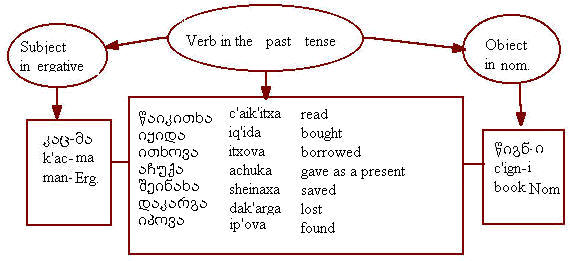 |
| student-i | megobar-s | weril-s | swers |
| st'udent'-i | megobar-s | c'eril-s | sc'ers |
| student-Nom.(Subj.) | friend-Dative (Ind.Object) | letter-Dative (Direct Obj.) | is writing |
|
|
|
|
|
|
|
|
|
|
|
|
|
|
|
Nino has bought a silver ear-rings.
| mama-s | uyvars | televizor-is | yureba |
| mama-s | uq'vars | t'elevizor-is | q'ureba |
| father-Dative (Subj.) | loves | TV-Genitive | watch.Nominative |
Father loves to watch TV
| gogona-s | sibnel-isa | eSinia |
| gogona-s | sibnel-isa | eshinia |
| girl-Dative (Subject) | darkness-Genitive | is afraid |
The girl is afraid of darkness
The instrumental case can express:
| daTo | Cangl-iT | Wams |
| dato | changl-it | ch'ams |
| Dato (short form of a name Davit) | fork-Instrumental | eats |
Dato is eating with the fork.
| es | kaba | xel-iT | mo-v-qsove |
| es | k'aba | xel-it | mo-v-ksove |
| this | dress | hand-Instrumental | I knit |
I have knit this dress by hand.
| amayob-s | Tavisi | qveyn-iT |
| amaq'obs | tavisi | kveq'n-it |
| be proud | his (own) | country-Adverbial |
He / she is proud of his / her country.
| gia | aq | gadmovida | ojax-iT |
| gia (name of a man) | ak | gadmo-vid-a | odzhax-it |
| Gia.Nom. | here | move | family-Instrumental |
Gia has moved here with his family.
| deda-m | gakvirveb-iT | Semo-m-xed-a |
| deda-m | gak'virveb-it | shemo-m-xed-a |
| mother-Ergative | surprise-Instrumental | looked at me |
Mother looked at me surprised.
| is | dil-iT | adre | dgeb-a |
| is | dil-it | adre | dgeb-a |
| He / she | morning-Instrumental (in the morning) |
early | rises |
He / she gets up early in the morning.
| CrdiloeT-iT | ca | mo-i-Rrubl-a |
| chrdiloet-it | ca | mo-i-grubl-a |
| north-Instr. | sky | became cloudy |
The sky became cloudy to the north.
N o t e:
These forms, since they express time and place, are
considered
to have formed a new group, adverbs, and since they are no longer
classified
as nouns thay cannot be declined like nouns.
The advebial case can express:
| man | wyal-i | Rvino-d | gada-aqci-a |
| man | c'q'al-i | gvino-d | gada-akci-a |
| he.Ergative | water-Nominative | wine-Adverbial | transformed |
He transformed the water into wine.
| elene | av-ad | aris |
| elene | av-ad | aris |
| elene | bad-Adverbial case | is |
Elene is sick.
| Zvel-ad | aq | xalx-s | ucxovria |
| dzvel-ad | ak | xalx-s | ucxovria |
| old-Adverbial | here | people-Dative (Subject) | lived |
It seems that people lived here in the old times.
| mindvr-ad | Tovl-i | aRar | id-o |
| mindvr-ad | tovl-i | agar | id-o |
| field-Adverbial case | snow-Nom (Subject) | not any more | lied |
There was not snow on the field any longer.
| giorgi-m | saxl-is | asaSenebl-ad | masala | iyid-a |
| giorgi-m | saxl-is | asashenebl-ad | masala | iq'id-a |
| giorgi-Ergative | house-Genitive | smth.that shall be built -Adverbial | material.Nominative | bought |
Giorgi has bought material in order to build a house.
The only one function of the vocative is to address
to a second person subject:
| megobar-o, | weril-i | mo-m-were |
| megobar-o | c'eril-i | mo-m-c'ere |
| friend-Vocative | letter-Nominative | write to me |
Friend, write a letter to me.
Other
functions of the nominative and dative
The nominative can express:
| nana | maswavlebel-i | aris |
| nana | masc'avlebel-i | aris |
| nana.Nom. (Subj.) | teacher-Nom. (Nominal part of the compound predicate) | is (Verbal part of the comp. predicate) |
Nana is a teacher
The verbal part of a compound predicate is
usually
reduced in the third person:
| nana | maswavlebel-i-a |
| nana | masc'avlebel-i-a (<masc'avlebel-i aris; the suffix -a is a shortened form of the verb aris) |
| nana.Nom (Subj.) | teacher-Nominative-is |
Nana is a teacher
| nino | mTel-i | wel-i | marto | iyo |
| nino | mtel-i | c'el-i | mart'o | iq'o |
| Nino | whole-Nom. | year-Nom | alone | was |
The dative can express:
| Cemi | Zma | SabaT-s | Camova |
| chem-i | dzma | shabat-s | cha-mov-a |
| my-Nom. | brother.Nom. | saturday-Dative | preverb-come-III Subject (will come) |
My brother will arrive on Saturday.
| biW-ma | qalaq-s | wasvla | gadawyvita |
| bich'-ma | kalak-s | c'asvla | gadac'q'vit'a |
| boy-Ergative | town-Dative | go.Nominative | decided |
The boy has decided to go to the town
A noun phrase often consists of a noun (head noun) and an adjective or another noun (attribute). In the noun phrase white houses house the noun housesis the head noun, modified by the attribute white.
A noun may modify another noun, e. g.:
The word order in noun phrases in modern Georgian
is:
Attribute + Head noun, e. g.:
| megobr-is | wign-i |
| megobr-is | c'ign-i |
| friend-Genitive | book-Nominative |
When used as attributes, nouns in the genitive case
do
not decline in modern Georgian. Only the so called head noun declines.
Note that the attribute megobr-is megobr-is
'friend' is placed before the head noun wign-i,
c'ign-i
'book'.
| Nominative | megobr-is | wign-i |
| Ergative | megobr-is | wign-ma |
| Dative | megobr-is | wign-s |
| Genitive | megobr-is | wign-is |
| Instrumental | megobr-is | wign-iT |
| Adverbial | megobr-is | wign-ad |
| Vocative | megobr-is | wign-o |
| Nominative | megobr-is | c'ign-i |
| Ergative | megobr-is | c'ign-ma |
| Dative | megobr-is | c'ign-s |
| Genitive | megobr-is | c'ign-is |
| Instrumental | megobr-is | c'ign-it |
| Adverbial | megobr-is | c'ign-ad |
| Vocative | megobr-is | c'ign-o |
Examples of the head noun or the attribute in the plural, e. g.:
megobr-eb-is wign-i
megobr-eb-is c'ign-i
the friends' book
megobr-is wign-eb-i
megobr-is c'ign-eb-i
the friend's books
megobr-eb-is wign-eb-i
megobr-eb-is c'ign-eb-i
the friends' books
More information:
The reversive order of the
noun phrase is also possible: Head noun + Attribute, e. g.:
| wign-i | megobr-is(a) |
| c'ign-i | megobr-is(a) |
| book-Nominative | friend-Genitive |
This is a very rare and stylistically marked order in modern Georgian. This was widespread and actually the usual word order in Old Georgian. In modern Georgian in case of reversive order, both members of noun phrase decline:
Declension of a noun phrase with reversive word
order
in modern Georgian
| Nominative | wign-i | megobr-is-a-0 |
| Ergative | wign-ma | megobr-is-a-m |
| Dative | wign-s | megobr-is-a-s |
| Genitive | wign-is(a) | megobr-is-a |
| Instrumental | wign-iT | megobr-is-a |
| Adverbial | wign-ad | megobr-is-a-(d) |
| Vocative | wign-o | megobr-is-a-v |
| Nominative | c'ign-i | megobr-is-a-0 |
| Ergative | c'ign-ma | megobr-is-a-m |
| Dative | c'ign-s | megobr-is-a-s |
| Genitive | c'ign-is(a) | megobr-is-a |
| Instrumental | c'ign-it | megobr-is-a |
| Adverbial | c'ign-ad | megobr-is-a-d |
| Vocative | c'ign-o | megobr-is-a-v |
More information about noun phrase:
The declension of both members (and if more members appeared, then of all members) was more complete in Old Georgian, e. g.:
Nom. sartyel-i tyav-isa
aqlem-isa-jsa-j
Nom. sart'q'el-i t'q'av-isa aklem-isa-jsa-j
Nom. belt of camel skin
Erg. sartyel-man tyav-isa
aqlem-isa-jsa-man
Erg. sart'q'el-man t'q'av-isa aklem-isa-jsa-man
The plural of the head noun was marked on the attribute too:
Nom. sartyel-n-i tyav-isa
aqlem-isa-jsa-n-i
Nom. sart'q'el-n-i t'q'av-isa aklem-isa-jsa-n-i
Nom. belts of camel skin
Erg. sartyel-Ta tyav-isa
aqlem-isa-jsa-Ta
Erg. sart'q'el-ta t'q'av-isa aklem-isa-jsa-ta
© Manana Kock Kobaidze