The
Georgian alphabet -- an introduction
Configuration
and names
Chronology
and spheres of use of the Georgian alphabet
The
origin of the Georgian alphabet
The
order of letters in the Georgian and Greek alphabets
Later
changes made in Georgian alphabet
Georgian manuscripts
References
The Georgian alphabet -- an introduction
Among the Caucasian languages currently spoken in Georgia (Georgian, Megrelian, Svan, Abkhaz, Batsbi, Udi), only Georgian and Abkhaz have their own scripts.
Until recently the Georgian language was considered to be the only language among the Caucasian languages to have a long documented history, back to the fifth century C. E:., whereas other Caucasian languages are documented only since the nineteenth-twntieth centuries. Thanks to recent investigations undertaken by theGeorgian scientist Zaza Aleksidze, one more Caucasian language - Albanian - with documented texts from the fifth century C. E., has become known to the world.
The first attempt to create a script for the Abkhaz language dates from the 1860s. The Abkhaz literary (written) language dates from the1920s.Since its creation the Abkhaz script has during different periods been based on the Cyrillic, Georgian, Latin, on the Georgian once more, and then again on the Cyrillic script.
The Georgian literary language has one and a half millennia years of documented history. Recent archeological excavations have unearthed Georgian inscriptions dating from the frist to the third C. E. in Nekresi in eastern Georgia. These inscriptions are being closely examined now, but the Georgian alphabet is still dated from the fifth century C. E.
The Georgian alphabet has had three main stages of development.
Configuration and names
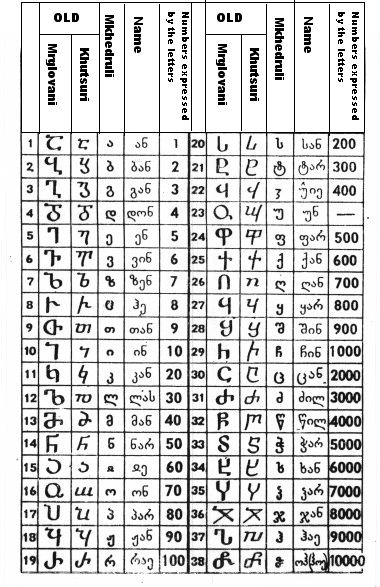
Asomtavruli is the oldest type of the Georgian script.
All letters have one and the same size in Asomtavruli and are written between
two lines. The name Asomtavruli means Capital. Another name for
this script is Mrglovani // Mrgvlovani, meaning Round.
The next stage in the development ofthe alphabet-- Nuskhuri or Khutsuri (Nuskha-Khutsuri) -- has more squared forms.The letters are written between four lines. Depending on the size of the letters four different groups are attested. "Nuskha" means written, writing. "Nuskhuri" means writing from, like in writing // handwriting. The name Khutsuri means for ecclesiastic purposes. This term ("Khutsuri") arose in the thirteenth century and involved both Mrglovani and Nuskhuri as ecclesiastic scripts in opposition to Mkhedruli as a non-ecclesiastic script. Nowadays the term "Khutsuri" usually means the same as "Nuskhuri".
Mkhedruli has developed from Nuskhuri (Khutsuri). The name Mkhedruli means for men of the world. The squared configuration of the Nuskhuri letters has changed into more rounded forms in Mkhedruli. Four groups according to the size of the Nuskhuri letters are maintained in Mkhedruli:
1. a, i, T, o
2. b, z, n, m...
3. g, d, e, v...
4. q, W
For example, a word containing letters of all four sizes is quTaisi Kutaisi (a town in west Georgia).
There are no capital letters in Mkhedruli.
The famous Georgian linguist and author of Georgian Grammar, Ak'ak'i Shanidze, suggested reviving Mrglovani (Asomtavruli) and using its letters for capital letters in the Modern Georgian script (Mkhedruli),but this proposal was unsuccessful. One example of this effort is a collection of linguistic works devoted to Ak'ak'i Shanidze printed with these principles (Orioni Akaki Shanidzes, Tbilisi, 1966).
Chronology
and spheres of use of the Georgian alphabet
The most ancient Georgian inscriptions are in the Mrglovani
(Asomtavruli) script. Found in Palestine, near Bethlehem (C'ereteli 1960),
they date back to the 430s C. E. ; and the inscriptions, found in the Bolnisi
Sioni church, near Tbilisi, have been dated from the 90s of the fifth century.
By the recent investigations the inscriptions from Bolnisi date from the
fourth-sixth centuries (Sardzhveladze 1997; Danelia and Sardzhveladze 1997).
New archeological excavations have discovered Georgian inscriptions dating
from the first to the third centuries C. E. in Nekresi
in eastern Georgia.
The first inscriptions in Nuskhuri, or Nuskha-Khutsuri, date from 835; they are in the Sioni Church in At'eni near Gori, in eastern Georgia (Aleksidze 1983), and came into common use in the tent-eleventh centuries. Mrglovani was used for capital letters in titles and initials. Nuskhuri (Khutsuri), with Mrglovani letters for capitalisation, is still used in the Georgian Orthodox Church.
The first inscription in Mkhedruli is also found in the Sioni Church in At'eni in eastern Georgia and belongs to the period c.980 (Abramishvili and Aleksidze 1978; Aleksidze1983). Mkhedruli has been the script for all non-ecclesiastic texts since the twelfth century.
Parallel use of Mrglovani and Nuskhuri(Khutsuri) was common in the tenth-eleventh centuries with some manuscripts written in Mrglovani and others in Nuskhuri during this period. In some works both scripts are attested. For instance, one part of Shat'berdis k'rebuli ("Collected works from Shat'berdi") from the tenth century is written in Mrglovani but another part in Nuskhuri.
Since the twelfth century, when Mkhedruli became the common script, the main functional distinction between Mrglovani and Nuskhuri, on the one hand, and Mkhedruli, on the other, has been that all ecclesiastical literature has been written with Khutsuri letters and all non-eclesiastical literature -- the King's orders, resolutions of the court and other documents, as well as non-ecclesiaistical poems and prose -- with Mkhedruli.
The
origin of the Georgian alphabet
Different hypotheses have been put forward concerning
the origin of the Georgian alphabet. The Old Georgian tradition (in particular,
Leonti Mroveli, the eleventh-century historian) ascribes the creation of
the Georgian alphabet to Parnavaz, the king of Georgia in the third century
B.C.E.
Some researchers maintain that the Georgian alphabet was created before Christ (Dzhavakhishvili 1949; Pavle Ingoroq'va 1941; Ramaz P'at'aridze 1980...), while others (K'orneli K'ek'elidze, Ak'ak'i Shanidze...) argue that the Georgian alphabet was created after Christianity was adopted as the official religion in Georgia. The script used in the Georgian state before the creation of the Georgian alphabet must have been Greek and Aramaic (inscriptions have been found in Armazi, near the old capital of Georgia, Mtskheta). T. Gamkrelidze (1989) has showed that the Greek alphabet seems to be an organizing principle behind the oldest Georgian script. According to the newest sources the oldest Georgian inscriptions from Nekresi precede Christianity as the official religion in Georgia.
Regarding the widespread legend about Mesrop-Masthots (the creator of the Armenian script) as the "inventor" of the Georgian and Old Caucasian Alban scripts, we note that this "theory" does not have a scientific basis. This is a later insertion made for certain religious and ecclesiastic purposes in some Armenian sources (Aleksidze 1968). Besides, even this insertion mentions that Mesrop-Mashtots did not know the Georgian and Albanian languages, an admission that reveals the character of this insertion.
Graphically the Georgian alphabet is independent, based on a combination of perpendicular lines and circles (Tamaz Gamq'relidze, 1989:170). Zaza Aleksidze has published the tables for comparison of Ethiopian, Georgian, Armenian and Albanian scripts (Aleksidae 2003: 106-113) but he stresses that further investigation is necessary before reaching any final conclusions (Aleksidze 2003: 167). Finally, a hypothesis about the Ethiopian alphabet as a graphic source for the Georgian, Albanian and Armenian scripts has also been proposed (Sevak 1962: 42-54).
The order of letters in the Georgian alphabet follows that of the Greek alphabet supporting the argument that the initial model for the creator of the Georgian alphabet must have been the Greek alphabet (Tamaz Gamq'relidze, 1989:129-157).
The
order of letters in the Georgian and Greek alphabets
There are 37 letters in both Mrglovani and Nuskhuri,
and both alphabets are phonemic, which means that every phoneme (vowels
and consonants) has its corresponding unique letter in the alphabet. There
were some exceptions in Mrglovani and Nuskhuri writing, that are explained
by influence from the Greek alphabet as the original model for the Georgian
alphabet. The order and the numerical value of the letters in the Georgian
alphabet were the same as in the Greek alphabet. The letters expressing
specific Georgian sounds have been added at the end of the alphabet.
The following exceptions in the Old Georgian alphabet were made in order to maintain the same order of letters as in the Greek alphabet, and consequently, to maintain the same meaning of letters as the signs expressing the numbers (see table above) as they do in the Greek alphabet (Tamaz Gamq'relidze, 1989:129-157):
1. To devise letters expressing a sequence of two sounds (two phonemes):
3. To devise a letter for a positional variant of a phoneme in order to fill in the "empty" place of the Greek alphabet:
Later
changes made in Georgian alphabet
Later, in the eleventh-twelfth centuries, under Greek
influence, the letter f appeared in certain
loan words in the works of some Elinophil Georgian philosophers and theologians.
In the eighteenth century Antony I, Katholikos of Kartli, the author of
Georgian
Grammar, added the letter expressing the sound w
to the
Georgian alphabet. In the nineteenth century Ilia Ch'avch'avadze, the Georgian
writer and prominent public figure, removed the letters which expressed
sounds that had disappeared from the literary language, thereby restoring
the correspondence between pronunciation and spelling and leaving thirty-three
letters in the Georgian alphabet.
Georgian manuscripts
For the oldest Georgian inscriptions, see Chronology
and sphere of use of the Georgian alphabet
The oldest Georgian literary monument "C'amebaj c'midisa Shushanik'isi, dedoplisa" (Martyrdom of Saint Shushaniki, of the Queen), by Iak'ob Khucesi dates from the fifth century C. E.
The oldest Georgian manuscript comes from the turn of the 6-7th centuries. It is a palimpsest: a manuscript where the oldtextis partially removed and the same page of skin is used for new handwriting in order to save skin. The oldest text on this palimpsest is Georgian,the newer (eleventh century) is Hebrew. The Georgian text contains a fragment from the prophet Jeremiah. The text is written in so-called "xan-met'i" which means that some morphological markers are represented as x- instead of by their later and modern variants, e.g., the second-person marker was x- in any position (x-it'q'ui instead of the modern it'q'vi).One page of this palimpsest is kept at Oxford College Library, two pages at University Library Cambridge.
There are about ten thousand Georgian manuscripts kept
in museums and libraries of Georgia, Russia, Germany, Austria, Great Britain,
France, Italy, the USA and other countries. However, the majority of manuscripts
are kept at the K'ek'elidze Institute of Manuscripts of the Georgian Academy
of Sciences, and other Georgian libraries and museums. Important collections
of Georgian manuscripts are also kept on the mountain of Sinai, as well
as in Jerusalem and in Greece. Considerable work has been conducted at
Georgian scientific institutions in order to find, collect, study and publish
many Georgian manuscripts.
Abramishvili, Guram and Zaza Aleksidze, 1978: Mkhedruli damc'erlobis sataveebtan, At the beginning of Mkhedruli script,Tbilisi,Cisk'ari N5: 135-144; N6: 128-137
Aleksidze, Zaza. 1968: Ep'ist'oleta c'igni. somxuri teksti kartuli targmanit, gamok'vlevita da k'oment'arebit. gamosca Zaza Aleksidzem, Tbilisi, Mecniereba
Aleksidze, Zaza. 1983: At'enis sionis otkhi c'arc'era, Four inscriptions from Ateni Sioni,Tbilisi
Aleksidze, Zaza. 2003: K'avk'asiis albanetis damc'erloba, ena da mc'erloba, Caucasian Albanian script, language and literature, Tbilisi, Biblical Theological College
C'ereteli, Giorgi. 1960: Udzvelesi kartuli c'arc'erebip'alest'inidan The oldest Georgian inscriptions from Palestina.Tbilisi
Danelia, K'orneli and Sardzhveladze, Zurab. 1997: Kartuli paleograpiis sak'itxebi, Questions of Georgian Paleography, Tbilisi
Dzhavakhishvili, Ivane. 1949: Kartuli damc'erlobatmcodneoba anu p'aleograpia, Georgian Palography, Tbilisi, Iniversity Press
Gamq'relidze, Tamaz.1989: C'eris anbanuri sistema da dzveli kartuli damc'erloba, The alphabetic system of writing and the Old Georgian script, Tbilisi, Mecniereba
Ingoroq'va, Pavle. 1941: Kartuli damc'erlobis dzeglebi ant'ik'uri xanisa, Moambe of the Institute of Language, History and Material Culture: X: 411-427
P'at'aridze, Ramaz. 1980: Kartuli asomtavruli Georgian Asomtavruli, Tbilisi, Nak'aduli
Sardzhveladze, Zurab. 1997: Dzveli kartuli ena, The Old Georgian language, Tbilisi, Tbilisi State Pedagogical University Press
Tchilashvili, Levan. The Pre-Christian Georgian Inscription
from Nek'resi, in "Kartvelologi" (Ed. Elgudzha Khintibidze), No7 2000